
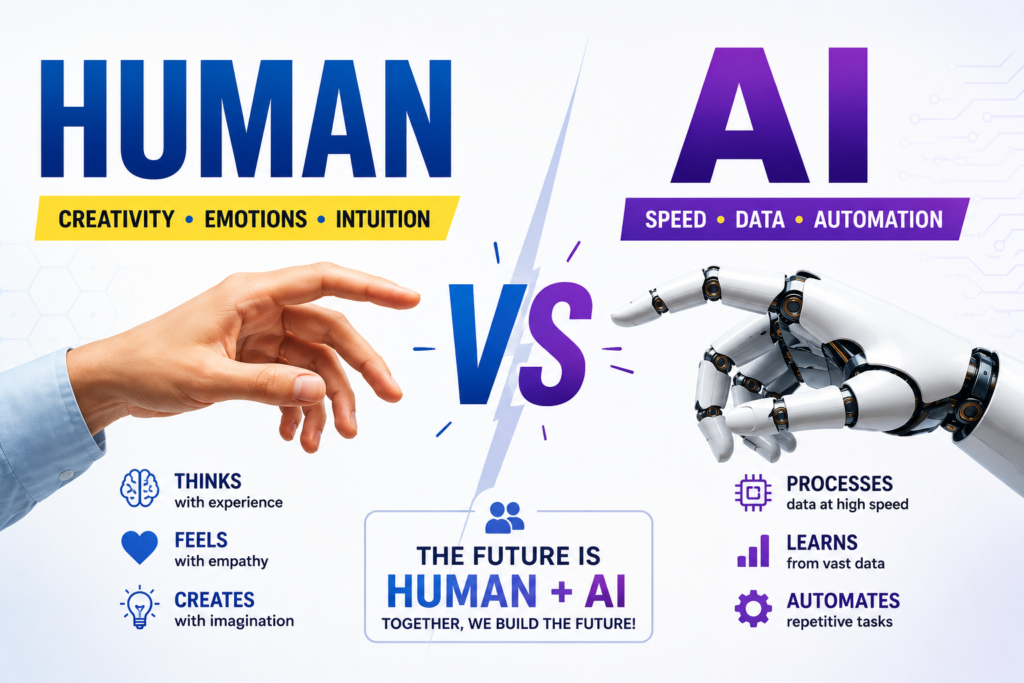
For the past two years, artificial intelligence was mostly discussed as a productivity tool. But in 2026, the conversation has changed completely.
Now the biggest global debate is simple:
Is AI starting to replace human workers?
Recent layoffs across major tech companies are making that fear look more realistic than ever.
AI Layoffs Are No Longer Just a Theory
In recent months, several global companies including Meta, Amazon, Coinbase, Freshworks, Cloudflare, Snap, and General Motors announced major layoffs while simultaneously increasing investments in artificial intelligence.
Meta alone is reportedly planning workforce reductions that could eventually impact more than 20% of its employees as the company spends billions on AI infrastructure and AI-assisted operations.
Freshworks revealed that AI now generates more than half of its internal code, reducing the need for some traditional software development work.
Cloudflare described its restructuring strategy as moving toward an “agentic AI-first operating model.”
This is not happening only in Silicon Valley anymore.
It is becoming a global business trend.
Companies Are Quietly Rebuilding Around Smaller Teams
One major shift in 2026 is that companies are no longer treating AI as a support tool alone.
They are redesigning operations around it.
General Motors recently laid off hundreds of IT employees while openly saying the company now wants more AI-focused engineers and specialists instead of traditional IT roles.
Coinbase is also restructuring to become more “AI-native,” believing smaller AI-assisted teams can operate more efficiently.
This signals a deeper transformation:
fewer routine roles
leaner corporate teams
higher demand for AI-skilled workers
The old hiring model is changing fast.
White-Collar Jobs Are Now Under Pressure
For many years, automation mainly affected factory workers and repetitive manufacturing jobs.
Generative AI is different.
It directly impacts:
- customer support
- coding
- content writing
- marketing
- data entry
- finance operations
- HR documentation
- administrative work
Even outsourcing-heavy economies like India are beginning to feel pressure from AI automation in back-office services and support operations.
This is why AI discussions suddenly feel personal for millions of office workers.
But The Situation Is Not Fully Negative
Despite the fear, AI is not creating mass unemployment everywhere.
In fact, many companies are still hiring aggressively for:
- AI engineering
- AI infrastructure
- cybersecurity
- AI operations
- AI governance
- prompt engineering
- automation management
According to Thomson Reuters’ 2026 professional services report, generative AI adoption inside organizations has nearly doubled within a year.
At the same time, NVIDIA CEO Jensen Huang recently argued that AI may actually increase demand for skilled physical and technical workers such as electricians, technicians, and infrastructure specialists.
So the future may not simply become:
“AI replacing everyone”
Instead, it may become:
“AI changing which skills are valuable”
The Biggest Risk Is For Repetitive Knowledge Work
The jobs most vulnerable right now are not necessarily low-paying jobs.
The biggest risk appears to be repetitive digital work:
- basic coding
- repetitive reporting
- standard documentation
- repetitive analysis
- template-based writing
Research papers published in 2026 are already showing evidence that firms are slowly replacing portions of outsourced human work with AI systems because AI tools are becoming significantly cheaper and faster.
That does not mean humans disappear completely.
But it does mean one employee with AI tools may now do the work that previously required several people.
The New Global Trend: “Human + AI”
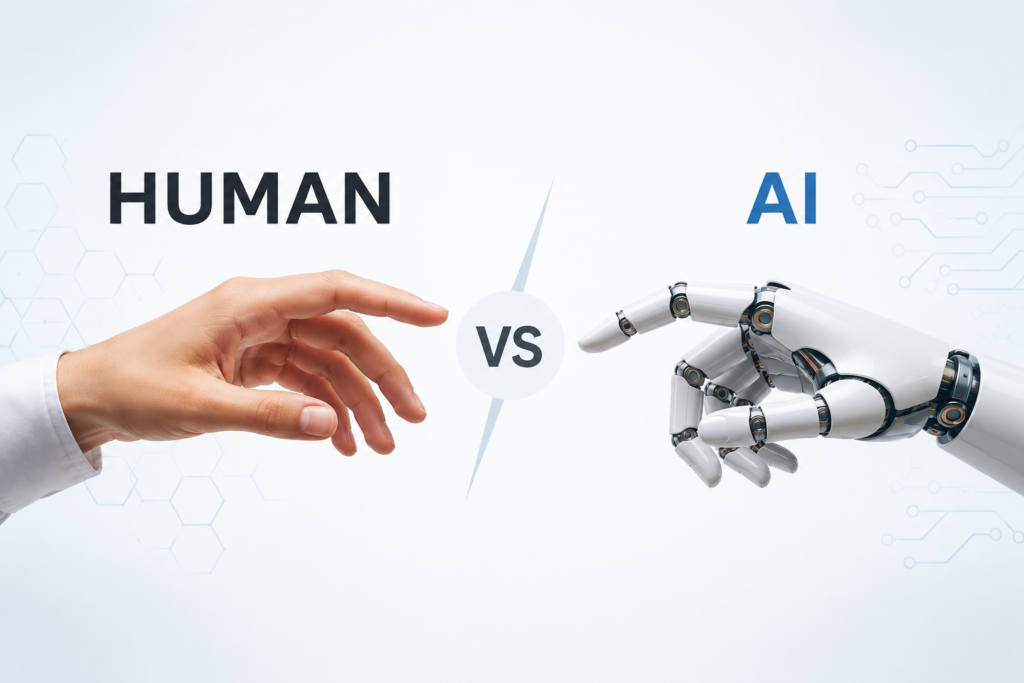
Interestingly, many companies are also discovering that AI alone is not enough.
Some studies show that productivity gains from AI are real, but businesses still struggle with quality control, accuracy, and workflow reliability.
This is why many experts now believe the future workplace may become:
- AI-assisted humans
instead of
- fully automated companies
Employees who learn AI tools early may actually become more valuable than those who completely avoid AI.
Final Thoughts
The global AI job shift in 2026 is now real.
The layoffs are real.
The restructuring is real.
And the fear surrounding AI is also real.
But the situation is more complex than “robots replacing humans.”
What is actually happening is this:
- repetitive work is shrinking
- AI-assisted work is growing
- skill expectations are changing rapidly
The people most at risk may not be workers who lack degrees.
It may be workers who refuse to adapt.
In the next few years, understanding AI tools could become as important as knowing how to use computers or the internet in previous generations.
The AI revolution is no longer coming.
It has already entered the workplace.
About GenAIQuant
GenAIQuant is an independent platform covering the latest developments in Artificial Intelligence, AI tools, future technology, cybersecurity, and global tech trends.
🌐 Website: GenAIQuant