
Common AI Myths and the Real Facts About AI
Artificial Intelligence (AI) is growing very fast in today’s world. We use AI in mobile phones, social media, online shopping, banking, hospitals, and even in schools. Because AI is becoming popular, many people have different ideas and fears about it. Some of these ideas are true, but many are only myths. Understanding the truth about AI is very important because it helps people use technology wisely.
This article explains some common myths about AI and the real facts behind them.
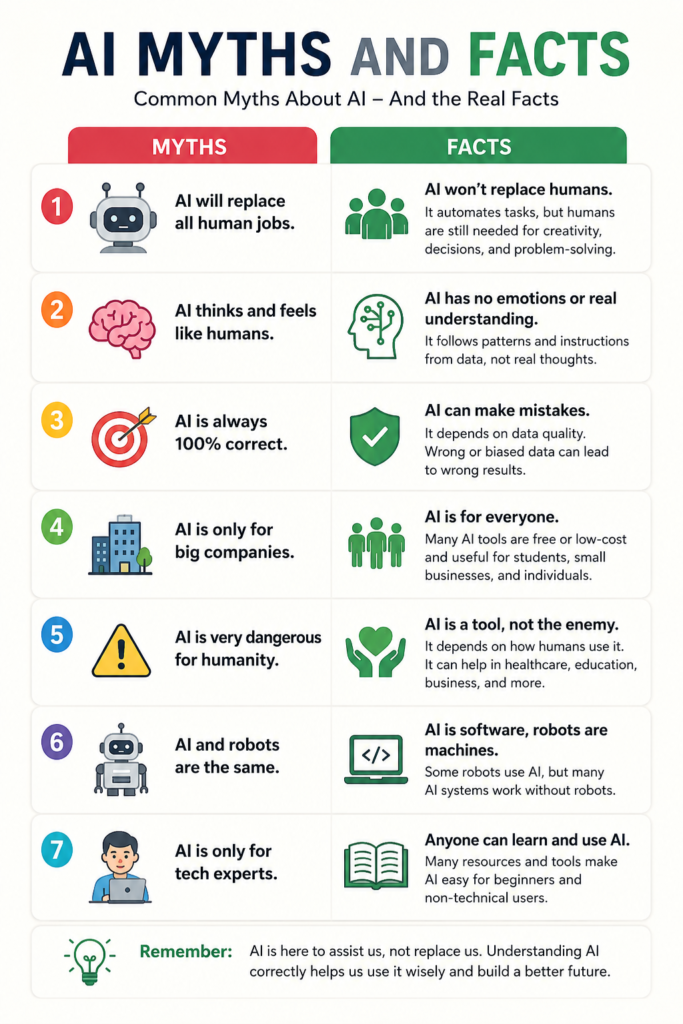
Myth 1: AI Will Completely Replace Humans
Many people think AI will take all human jobs and humans will become useless.
Fact:
AI can automate some tasks, but it cannot fully replace humans. AI works based on data and instructions. Humans still need creativity, emotions, critical thinking, leadership, and decision-making skills. For example, AI can help doctors analyze reports, but it cannot fully replace a doctor’s experience and care for patients.
AI usually helps humans work faster and better instead of replacing them completely.
Myth 2: AI Can Think Like Humans
Some people believe AI has feelings, emotions, and human intelligence.
Fact:
AI does not think like humans. AI only follows patterns and instructions from data. It does not have emotions, consciousness, or personal opinions. When AI gives answers, it is based on training data and algorithms, not real understanding.
Humans can feel happiness, sadness, love, and fear. AI cannot experience these emotions.
Myth 3: AI Is Always Correct
People often trust AI systems completely and think they never make mistakes.
Fact:
AI can also make errors. AI systems depend on the quality of data they are trained on. If the data is wrong, incomplete, or biased, the AI can produce incorrect results.
For example, a face recognition system may sometimes identify the wrong person. This is why human supervision is still important when using AI systems.
Myth 4: AI Is Only for Big Companies
Many believe only large technology companies can use AI.
Fact:
Today, AI tools are available for everyone. Students, small businesses, teachers, and content creators can also use AI. Many free AI tools help people write articles, create images, learn coding, translate languages, and improve productivity.
AI technology is becoming more affordable and accessible every year.
Myth 5: AI Is Dangerous for Humanity
Movies often show AI robots destroying the world, which creates fear among people.
Fact:
AI itself is not dangerous. The real issue depends on how humans use it. AI can be used for both good and bad purposes, just like any other technology.
For example:
* AI can help doctors detect diseases early.
* AI can improve online education.
* AI can also be misused for fake videos or cyber attacks.
The responsibility is on humans to use AI ethically and safely.
Myth 6: AI Can Learn Without Human Help
Some people think AI becomes intelligent completely on its own.
Fact:
AI needs human-created data, training, and programming. Humans design the models, provide information, and improve the systems. Without human input, AI cannot function properly.
Even advanced AI systems need regular updates and monitoring from experts.
Myth 7: AI and Robots Are the Same
Many people think AI always means robots.
Fact:
AI and robots are different things. AI is software or intelligence that performs tasks using data. Robots are physical machines. Some robots use AI, but many AI systems exist without robots.
For example:
* Voice assistants use AI but are not robots.
* Self-driving cars use AI software.
* A factory robot may work without advanced AI.
Myth 8: AI Is Only for Technology Experts
People sometimes believe AI is too difficult for normal users.
Fact:
Anyone can learn basic AI concepts. Many websites, apps, and online courses teach AI in simple ways. Students and beginners can start learning AI without being experts in programming.
Today, AI is becoming part of daily life, so learning basic AI knowledge is useful for everyone
The Importance of Understanding AI Correctly
Believing false information about AI can create fear and confusion. Understanding the real facts helps people:
* Use AI responsibly
* Learn new skills
* Improve productivity
* Make better career decisions
* Avoid unnecessary fear
AI is a tool created by humans. It can help society in healthcare, education, business, agriculture, and many other fields when used properly.
Conclusion
AI is one of the most powerful technologies in the modern world. However, many myths about AI create misunderstanding among people. AI cannot fully replace humans, think like humans, or work perfectly without mistakes. It is simply a technology designed to assist humans in solving problems and improving efficiency.
Instead of fearing AI, people should learn about it and understand its real capabilities and limitations. The future of AI depends not only on technology but also on how humans choose to use it responsibly and ethically.
Read More from GenAIQuant
Official Website: https://www.genaiquant.com