
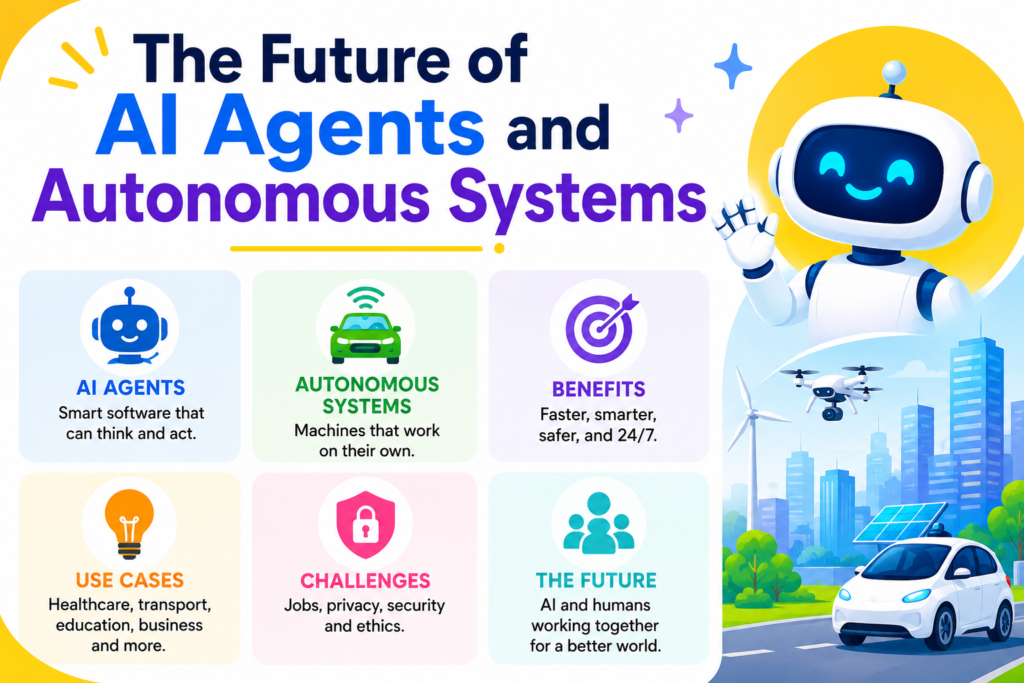
The Future of AI Agents and Autonomous Systems
Artificial Intelligence is growing faster than ever before. From chatbots and virtual assistants to self-driving cars and smart robots, AI is changing the way people live and work. One of the most exciting developments in this field is the rise of AI agents and autonomous systems. These technologies are expected to shape the future of businesses, education, healthcare, transportation, and many other industries in AIAgents and Autonomous Systems
But what exactly are AI agents and autonomous systems? And why are they becoming so important?
- What Are AI Agents?
AI agents are intelligent software programs that can perform tasks on their own. They can understand information, make decisions, and complete actions without needing constant human control.
For example, a virtual assistant like OpenAI ChatGPT can answer questions, write content, and help users solve problems. More advanced AI agents can even book appointments, manage schedules, analyze data, or handle customer support automatically.
These systems learn from data and improve over time. The more they interact with users and information, the smarter they become.
- What Are Autonomous Systems?
Autonomous systems are machines or software that can operate independently with little or no human help. They use AI, sensors, and real-time data to make decisions.
A self-driving car is a good example of an autonomous system. It can detect roads, traffic, and obstacles while driving safely without a human driver. Similarly, delivery drones, warehouse robots, and smart factories also use autonomous technology.
The goal of autonomous systems is to reduce human effort, improve efficiency, and complete tasks faster and more accurately.
How AI Agents Are Changing the World
AI agents are already becoming a part of daily life. Many companies use them to improve productivity and customer experience.
1. Customer Support
Businesses now use AI chatbots to answer customer questions 24/7. These bots can solve common problems quickly without needing a human support agent.
This saves time for both customers and companies.
2. Education
AI tools are helping students learn better. AI tutors can explain difficult topics, generate notes, create quizzes, and provide personalized learning experiences.
Students can learn at their own speed with the help of AI-powered systems.
3. Healthcare
AI agents are helping doctors analyze medical reports, detect diseases early, and manage patient records more efficiently.
In the future, AI may assist in surgeries and provide real-time health monitoring for patients.
4. Business Automation
Companies are using AI to automate repetitive work such as email replies, data entry, scheduling, and report generation.
This allows employees to focus on creative and strategic tasks instead of routine work.
The Rise of AI Agents in Everyday Life
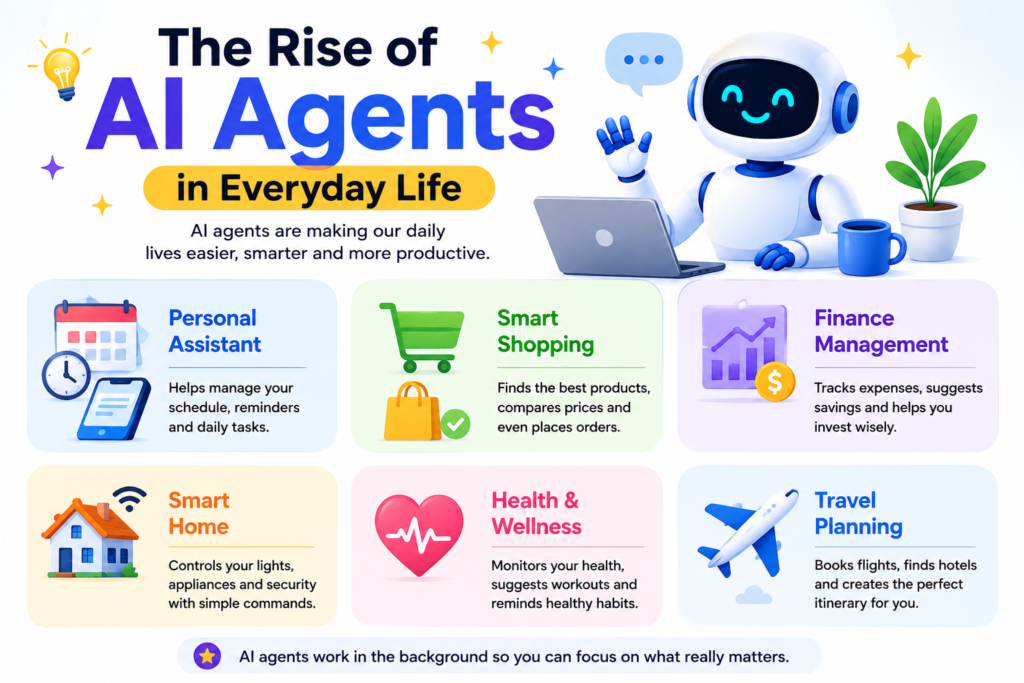
In the coming years, AI agents may become personal digital assistants for everyone.
Imagine waking up in the morning and your AI assistant already knows your schedule, checks traffic conditions, prepares your work reminders, and even suggests healthy meals for the day.
AI agents may also help people shop online, manage finances, plan travel, and control smart homes automatically.
As technology improves, these systems will become more natural, conversational, and helpful.
Autonomous Systems in the Future
Autonomous systems are expected to transform many industries.
- Transportation
Self-driving cars and autonomous trucks may reduce accidents caused by human mistakes. They could also lower transportation costs and improve traffic flow.
- Manufacturing
Smart factories with autonomous robots can work continuously with high accuracy. This increases production speed and reduces operational costs.
- Agriculture
Farmers are starting to use AI-powered drones and robots for planting, watering, and monitoring crops. These systems help improve farming efficiency and reduce waste.
- Space Exploration
Autonomous robots may play a major role in future space missions. They can explore dangerous environments where humans cannot easily survive.
Benefits of AI Agents and Autonomous Systems
There are many advantages to using these technologies.
* Faster decision-making
* Increased productivity
* Reduced human errors
* Better customer experiences
* Lower operational costs
* 24/7 availability
* Personalized services
AI systems can also analyze huge amounts of data much faster than humans. This helps businesses and organizations make smarter decisions.
Challenges and Concerns
Even though AI offers many benefits, there are also important concerns.
Job Displacement
Many people worry that automation may replace human jobs, especially repetitive and manual work.
However, experts believe AI will also create new career opportunities in technology, data science, cybersecurity, AI development, and robotics.
Privacy and Security
AI systems collect and process large amounts of personal data. Protecting this information is very important.
Companies must ensure that AI systems are secure and used responsibly.
Ethical Issues
AI decisions must be fair and unbiased. If AI systems are trained with incorrect or biased data, they may produce unfair results.
Governments and organizations are working on rules and ethical guidelines for responsible AI development.
The Human Role in an AI-Powered Future
Even as AI becomes more advanced, humans will still play an important role.
AI can assist people, but human creativity, emotions, leadership, and critical thinking cannot be fully replaced. The future will likely involve humans and AI working together rather than competing against each other.
People who learn AI-related skills today may have better career opportunities in the future. Understanding technology, problem-solving, and adaptability will become increasingly valuable.
Conclusion
The future of AI agents and autonomous systems looks incredibly powerful and transformative. These technologies are already changing industries and improving daily life in many ways.
From smart assistants and autonomous vehicles to healthcare and education, AI will continue to become a bigger part of the modern world. While there are challenges such as job changes, privacy concerns, and ethical questions, responsible development can help society benefit from these innovations.
AI is not just a technology of the future anymore. It is becoming a technology of the present. The people and businesses that learn to use AI wisely will likely lead the next generation of innovation and growth.
More Articles..www.genaiquant.com